Sunday, November 20, 2016

15 Popular Stars Who Became Criminals

TheRichest.com
by Mark Heidelberger

When it comes to the law, there’s no shortage of celebrities with a history of playing it fast and loose. They may feel like the same rules that apply to us mere mortals don’t necessarily apply to them. It could be that they expect their celebrity status to get them off with nothing more than a slap on the wrist. Perhaps those same emotions they’re so good at controlling for stage and screen get the better of them when the limelight’s not shining. Or maybe it just demonstrates that celebrities are human, prone to scrapes with justice just like the rest of us.

Of course, human or not, that doesn’t mean the media will treat them with the same disinterest and indifference as the next guy. Quite the contrary. When stars commit crimes, the news cycle is utterly relentless in its coverage, counting on viewers who want the guarded personal lives of celebrities demystified. Celebrities are used to riding the gravy train, so you can always count on the public to slow down and watch the train wreck. While this list is by no means exhaustive, here are 15 celebrities who found themselves operating on the wrong side of the law at one time or another (some more than once).


On September 11th, 2002, Nolte was arrested in Malibu after he fell asleep behind the wheel of his car and veered into opposing traffic on the Pacific Coast Highway. It was later found that he was driving while under the influence of a party drug called GHB, whose effects often resemble those of alcohol. Nolte later plead no contest to the misdemeanor charge, served three years’ probation and spent time in rehabilitation. Many of us remember the famous Polaroid that a Malibu police officer snapped of a disheveled, wild-haired Nolte the night he was arrested. However, despite popular belief, that was not the official mug shot, which was never released to the public. Nolte claims he was headed to an AA meeting at a church that night, but for reasons unknown changed his mind when he arrived and decided to go back home. Too bad. That meeting might have been the best thing he could have done for himself.


In December of 2001, Ryder was caught trying to shoplift $5,000 worth of clothes, hair products and a hand bag from Saks Fifth Avenue in Beverly Hills. Clerks had caught her ripping off tags and stuffing the clothes into a shopping bag she was carrying. While she beat a burglary charge, she was convicted of vandalism and grand theft, which ultimately lead to $3,700 in fines, 480 hours of community service, and restitution to Saks. During the arrest, she was also found carrying painkillers without a prescription, but denied being under the influence. While she was not charged with any drug-related crimes, she was ordered to attend drug counseling. Following a five-year hiatus, Ryder returned to acting in 2006, appearing in Richard Linklater’s adaptation of the Philip K. Dick novel A Scanner Darkly. Many fans were shocked as to why a wealthy celebrity would have to steal clothes. However, those who later saw the prices at Saks quickly found their confusion alleviated.


In April of 2007, Vick’s cousin, Davon Boddie, was arrested on drug charges and provided Vick’s home as his primary address. Upon searching the residence, authorities discovered evidence of dogfighting, including 54 malnourished dogs (primarily pitbulls), a blood-soaked fighting arena, training equipment, and various documentation describing the nature of the enterprise. On July 17th, Vick and three cohorts were indicted on federal charges of funding an illegal gambling operation and violating interstate commerce laws by transporting fighting dogs across state lines. The State of Virginia also brought charges of illegal dogfighting and cruelty to animals, where it came to light that Vick was at least aware of, if not complicit in, the hanging, drowning and electrocution of dogs who had underperformed in the ring. At this point, dog lovers everywhere who had never even considered the death penalty for serial killers were suddenly calling for its use on Vick. Instead, he was sentenced to 23 months in the federal doghouse, although he barked his way out in just 18.


Brown’s legal woes began on February 8th, 2009 when he beat up his then-girlfriend Rihanna, causing her facial injuries that required hospital treatment. He later plead guilty to one count of felony assault. But Brown was just getting started. On June 14th, 2012, he was involved in a fight with Drake at a New York City nightclub over Rihanna. On January 27th, 2013, he attacked singer Frank Ocean outside a West Hollywood recording studio over a parking spot. On October 27th, 2013, he was arrested for felony assault (yes, again) for punching a man outside a Washington DC hotel.  On November 10th, 2013, he was sentenced to 90 days’ anger management for throwing a rock through the window of his mother’s car. On June 2nd, 2016, he was accused of punching a woman in the face for trying to snap his picture after a performance. And on August 30th, 2016, he was arrested on suspicion of assault with a deadly weapon after a day-long stand-off with police outside his Tarzana home. Further instances abound, but this is an article, not a novel.


Unfortunately, Winona’s not the only “Heathers” cast member to have run-ins with the law. On December 29th, 1989, Slater was arrested for drunk driving after leading police on an early morning car chase that ended when he wrapped his Saab around a tree. His blood-alcohol limit was three times the legal California limit and the stunt netted him 10 days in jail. In 1994, he was arrested at JFK Airport for trying to board a commercial flight with an unloaded 9mm handgun. Then, in August of 1997, while under the influence of cocaine and heroin, he was arrested yet again for beating up his girlfriend, fashion editor Michelle Jonas, and a man who was trying to help her. When police arrived, he resisted arrest and kicked officer Julio Flores down a flight of stairs. He was sentenced to 90 days in jail, but only served 59. As a star on the top of the “unwanted touching tree,” he was also charged with third degree sexual abuse in May of 2005 for inappropriately grabbing a woman on the street.


Li-Lo’s collection of mug shots is beginning to look like its own yearbook album. Between 2007 and 2012, she racked up more than a dozen infractions. The lowlights: On May 26th, 2007, she’s charged with drunk driving and possession of cocaine after crashing her car in Beverly Hills. The lesson didn’t stick, because she gets arrested for the exact same charges again two months later (as well as driving with a suspended license, natch). She’s sentenced to one day in jail, but is released after serving a staggering 84 minutes. On May 20th, 2010, a bench warrant is issued when she skips a court date to attend the Cannes Film Fest, forcing her to chalk up 100K in bail. Subsequent fines and jail time rack up as she continues to violate the terms of her probation. On December 12th, 2010, a Betty Ford Clinic staff member accuses her of assault, although the charges are subsequently dropped. On February 9th, 2011, she’s taken into custody for trying to swipe a $2,500 necklace from a Venice jewelry store. And on November 29th, 2012, she’s nabbed for punching a woman in the face outside a Manhattan night club. All this lends credence to the theory that she got miscast in Mean Girls.


The Canadian pop star seems to be taking a few cues from the Chris Brown/Lindsay Lohan playbook. One, two or even three times in cuffs just isn’t enough to solidify your street cred. On December 30th, 2013, the Biebs and his entourage assaulted a limo driver who had the unfortunate task of chauffeuring them around. Barely two weeks later, he plead no contest to misdemeanor vandalism of a neighbor’s home and was ordered to pay nearly $81,000 in damages. Nine days after that, he was arrested in Miami Beach for illegal street racing and resisting arrest after unleashing a torrent of profanities at local police officers. Then, on August 29th, 2014, he was nabbed for assault and dangerous driving after his ATV collided with a minivan that, according to his lawyers, was being driven by a member of the paparazzi. While stars deserve some R&R too, it’s still boggling how many turn to violence simply because their picture was taken without their permission. Hello, you are famous!


Beyoncé’s better half may not be that much better after all. In October of 2001, music impresario, Roc Nation mogul and Obama BFF Jay Z turned himself into authorities for a stabbing incident that happened outside a listening party at the Kit Kat Club on December 2, 1999. He was originally charged with felony assault and faced up to 15 years in prison for sticking a blade into record producer Lance “Un” Rivera over what some speculate was a disagreement about female rapper Charli Baltimore. Ultimately, the mogul plead the charge down to third degree assault and was sentenced to a paltry three years’ probation. Rumors have also swirled for years that Jay Z was involved in orchestrating the murder of fellow rapper Big L, although no proof has ever been proffered and most consider it mere tabloid fodder. Either way, none of this seems to have hurt him, as Forbes estimates his 2016 net worth to be about $610 million.


Philadelphia native Smith found fame in the 1980’s as one half of the hip-hop duo DJ Jazzy Jeff and The Fresh Prince. But a poor decision in 1989 could have closed the gates to Bel Air permanently. According to police, Smith got into a verbal altercation with promoter William Hendricks – just days after his first Grammy win no less – and ordered his bodyguard to attack Hendricks. The assault left Hendricks with a fractured left eye orbit that required hospitalization, and Smith was subsequently charged with aggravated assault, simple assault, reckless endangerment and criminal conspiracy. Smith spent a night in jail at the West Philly police station as a result, with one witness claiming that the other inmates were bothering him all night long for autographs. Fortunately for Smith, the charges were later dropped, and he denies any wrongdoing to this day. He later starred on screen as Muhammad Ali, where his fighting talents were better suited.

White collar crime might not sound as exciting as good old-fashioned violence, but ask Wesley Snipes about getting caught doing it: it sucks just as much. In 2006, the Blade star was overseas in Namibia filming his new movie Gallow Walker when he was forced to return to Ocala, Florida to answer charges that he fraudulently claimed refunds of almost $12 million for both 1996 and 1997 taxes that he had already paid. He was also accused of failing to file any tax returns between 1999 and 2004, a period during which he made approximately $40 million. He eventually posted $1 million bond and was permitted to return to Namibia to finish his film. He was later found guilty on three misdemeanor counts of failing to file federal tax returns, went behind bars at McKean Federal Correctional Institution on December 9th, 2010, and served about 2.5 years of his three-year prison sentence. He was released on April 2nd, 2013, and as far as we know, has faithfully paid his taxes ever since.


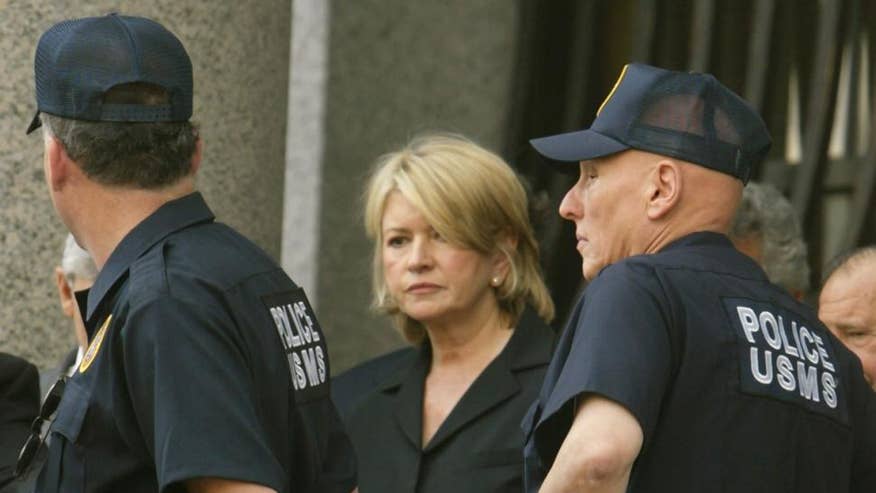
First, a little backstory. A biopharmaceutical company called ImClone was experimenting with a new cancer drug called Erbitux back in 2001. It had submitted the drug for FDA approval and got denied. You’re thinking, yeah, so, what does this have to do with Martha Stewart? Just hold on to your custom boutique throw pillows, we’re getting to it. An ImClone co-founder was arrested for advising family and friends to sell the stock before the FDA announcement was made, knowing it would plummet the value. One of those friends was Stewart. (Aha, now you’re getting it!) She sold some $200,000 worth of the doomed ImClone stock, saving herself from $45,000 in losses. This is called “insider trading” and it’s illegal. She was arrested in June of 2003 and later found guilty of securities fraud and lying to federal investigators. The 62-year-old home décor magnate was sentenced to five months of hard time, five months of house arrest, and two years of probation. While she had to step down as CEO of Martha Stewart Living Omnimedia, word is she still taught her fellow inmates how to crochet a mean doily.


Fans of the early 80’s sit-com seemed to get pelted with a barrage of bad news over the years as one cast member after another was arrested for various crimes. In 1987, Todd Bridges received a suspended sentence after pleading no contest to making a bomb threat. In 1988, he was tried and acquitted for attempted murder after allegedly shooting drug dealer Kenneth Clay eight times inside a crack house. Then in May of 1990, he was arrested again for cocaine trafficking in North Hollywood. Co-star Dana Plato also had multiple arrests, first for forging a drug prescription in 1982 (netting her 30 days in jail) and then for robbing a Las Vegas video store in 1991 with a pellet gun (she skated by with five years’ probation). Even Gary Coleman was taken into custody in 2010 when, during a civil disturbance involving his wife, authorities learned that he had an outstanding warrant stemming from a prior incident. His response when told of the warrant? “Whatchu talkin’ bout, Willis?!” (Okay, that was bad.)


On April 8th, 1988 in Dorchester, Massachusetts, Wahlberg violently attacked local Vietnamese resident Thanh Lam as Lam walked to his car with some beer he had just bought. According to reports, Wahlberg spewed racial epithets as he smashed Lam over the head with a five-foot-long wooden stick, leaving him unconscious. While evading police, he approached another Vietnamese man, Hoa Trinh, and punched him in the eye. Wahlberg initially believed that he had blinded Trinh, but it was later revealed that Trinh had already lost that eye in the Vietnam War. Wahlberg was initially charged with attempted murder, but later plead guilty to the lesser charge of criminal contempt. He was given a two-year sentence, but only served 45 days at Boston’s Deer Island House of Correction. Many believe that this stint in the brig incentivized him to turn his life around. And thank goodness it did, or we may have been forever deprived of the exquisite melodies of that super group we all came to know and love – The Funky Bunch.


It seems almost like the plot of a Hollywood movie that Blake himself might have starred in. On May 4th, 2001, the Baretta star went to dinner with his wife, Bonnie Bakley, at Vitello’s in Studio City. Witnesses described their appearance as “unhappy.” After the meal, she waited in the car on a side street while he went back to retrieve a gun he had left inside (later determined by police not to be the murder weapon). Bakley was shot to death in the car while he was gone. On April 18th, 2002, Blake was arrested and charged with her murder, while his longtime bodyguard, Earle Caldwell, was arrested for conspiracy. Two former stuntmen came forward with stories that Blake tried to hire them to kill Bakley, and gun residue was found on Blake’s hands shortly after the shooting. However, the defense team was able to poke enough holes in the prosecution’s case to create reasonable doubt, with jurors later describing the evidence against Blake as “flimsy.” Although he was ultimately found not guilty, he later was forced to pay a $2 million civil settlement to Bakley’s children. Ah, karma, the real killer.


Perhaps one of the largest and saddest falls from grace is that of Mr. Simpson – once a heralded football star, sports commentator and film actor. On June 12th, 1994, the bodies of his ex-wife Nicole and her friend Ron Goldman were found brutally slain outside her Brentwood home. Five days later, the LAPD requested that Simpson turn himself in on first degree murder charges; instead, Simpson fled in a white Bronco owned by his friend Al Cowlings and lead police on a long freeway chase that was beamed across the world via helicopter news feeds. The trial lasted from January 24th to October 3rd, 1995, eventually resulting in a not guilty verdict and Simpson’s freedom. However, like Blake, Simpson was later ordered to pay a multi-million-dollar civil judgment to Nicole’s and Ron’s families. Then, on September 13th, 2007, he was arrested again in an unrelated case and ultimately found guilty of robbery, burglary and kidnapping. He is currently serving a 33-year sentence in Nevada and will be eligible for parole on October 2nd, 2017, where he’ll likely have several reality show offers awaiting him if released.

Sunday, August 28, 2016

Here's a treatment for a Foot Locker spec spot I wrote. See what you think...


“My Court”

We start on a young, athletic, well-built BLACK MAN walking down the steps of a courthouse. He wears a suit and holds a briefcase.

He arrives at an outdoor basketball court with no one around. He sets down the briefcase and starts taking off his tie, then his jacket, then his buttoned-up shirt to reveal a sleek nylon tank top underneath. He slips off his pants and shoes to reveal a pair of gym shorts, then slides into a pair of brand new high-tops. He stands up and faces the hoop.

During this, we hear his voice-over:

“This is my court… It won’t ask me how my day was… Or whether I’m ready to proceed... This court doesn’t exchange pleasantries...”

BOOM. Suddenly our main man explodes to the basket in a series of slam dunks, reverse dunks and lay-ups, intercut with threes, jumpers, dribbling and the kind of sick ball handling that would impress Phil Jackson.

We continue to hear his voice-over as we watch this awesome display:

“But it doesn’t have any objections either… It doesn’t require any witnesses… There doesn’t have to be order at this court... Here, “all rise” has a whole different meaning… At this court, I’m the law… It doesn’t care if I take the fifth… In fact, it’s better if I don’t talk at all... This is my other practice…”

We see him go up for one more monster dunk, which changes from REGULAR SPEED to SLOW MO and back again, as we hear his final voice-over explain:

“Here, I’m the judge, jury and executioner.”

We show a CLOSE-UP of his face – it’s serious, a game face.

And then a FLARE CUT takes us to the FOOT LOCKER logo.

END.


Sunday, June 19, 2016

Christmas Comes A Little Early This Year

I recently produced a movie called "A New York Christmas," which Shoreline Entertainment will be releasing later this year. As part of the delivery items, I needed to create a press kit with production notes about the making of the film. Here is what I wrote. See what you think....

A New York Christmas
ABOUT THE PRODUCTION

               The story’s origins are rooted in the filmmakers’ deep-seated love of Christmas – a time each year when people of all colors, creeds, sizes, sexes and ages come together in joyous celebration. It’s a time for sharing and togetherness, a time for romance, a time to be with the ones you love. It’s a time to set aside differences and remember what makes us the same. At the heart of the story, writer-director Nathan Ives wanted to explore the lives of some people who appeared very different on the surface, but were united in their dramatic, funny and sometimes painful life experiences. In the early screenwriting stages, there seemed like no better city for this ensemble journey to unfold than the great melting pot that is the Big Apple. A downtown hotel, with its transient nature, also presented the perfect stage, both literally and figuratively, to glimpse briefly at the lives of eleven strangers... strangers who don’t look all that different from you and me.

               The journey began in early 2014 when Ives had caught the eye of businessman Brian Conley during a screening of Ives’s first feature film, It’s Not You, It’s Me. Conley saw that Ives had a knack for telling personal stories with a bittersweet blend of humor, pathos and empathy. The two decided to team up on a feature film, and the seeds of A New York Christmas were planted. During the script’s development phase, Ives and Conley worked closely on the characters together and flushed out the meaning behind each storyline. Once the script was further along, Ives reached out to his friend and former manager, Mark Heidelberger, to join him and Conley in producing the picture. Heidelberger had been producing movies and television for 15 years, and was not only a skilled line producer, but brought an abundance of knowledge in development, casting, post and distribution. At that point, the core producing team was assembled, and the three set out to make movie magic together.

               Once the script was in solid shape, they began reaching out to cast. One of the first actors on Ives’s go-to list was big screen veteran Ross McCall, who Ives had cast as the lead in It’s Not You, It’s Me. McCall had brought a great depth of emotion to the lead character in that film, and Ives had already conceived the role of Ben with McCall in mind. In addition, McCall’s great relationships with other strong actors (and his ability to get them on board) earned him an executive producer spot on the team. When casting director Sherrie Henderson began auditioning other leads, it quickly became obvious who was right for the roles. Jaime Ray Newman’s instant chemistry with McCall made their pairing a no-brainer. Richard Herd and Lee Meriwether literally brought decades of experience and a grandparent-esque likeability that’s so often missing in older characters today. Newcomers Maurice Mejia and Catherine Toribio simply knocked their auditions out of the park. Jamie Bamber, Linda Park, Jasika Nicole, Tracie Thoms and Chris Backus rounded out the ensemble, each bringing an impressive toolbox of acting skills that allowed them to fully embody their characters.

               Production was scheduled to begin in May of 2015. Ives had flown to Manhattan the Christmas before with a second unit cinematographer to get establishing shots and B-roll of the city. Now, the next big challenge was finding a location for principal photography in Los Angeles that could play as New York. It not only had to have that early 20th century urban architecture that so readily captures the feel of Manhattan, but had to pass for it outside the windows as well. Heidelberger had decided it was just too expensive to build all the hotel sets on a stage, which would have at least allowed for the use of matte painting backdrops, and therefore a normal daytime shooting schedule. Instead, the film would have to be shot mostly at night in order for the world outside the windows to believably play as Manhattan, which meant a tiring and unorthodox schedule for the crew. In addition, the tight budget meant many hotels that were used to big budget productions were out of the question. Ives and Heidelberger scoured downtown Los Angeles for just the right place. Fortunately, the Millennium Biltmore across from Pershing Square, right in the heart of the metropolis, met the producers’ artistic and budgetary qualifications; the team had found their new home for the next 12 days.

               The production took up one whole hallway on one floor for the first five days and the two-story, multi-room Presidential Suite for the remaining seven. Rooms served as the actors’ dressing rooms, makeup and wardrobe facilities, production offices and equipment staging areas. The shooting schedule was as tight as the budget, and with only two six-day weeks to shoot everything, Ives and director of photography Kenneth Stipe found themselves having to rip through an average of seven and a half pages a day. In addition, production designer Julian Brown was tasked with making each room look just different enough to create some aesthetic diversity, while still remaining similar enough to feel like they were all in the same hotel. Not having to load in to the location and wrap out each day allowed for more valuable shooting time. And the hotel rooms often doubled as crash pads for cast and crew weary from an entire night of shooting; but at the very least, they were extremely comfortable. In fact, the crew was consistently reminded that there could have been worse places to shoot all night.

               Despite all the obstacles, the production remained on schedule, and at the end of the 12 days, the producers had a treasure trove of footage that was beautifully designed, shot and acted. Now it was time to turn it into a cohesive narrative. Ives and Heidelberger began interviewing potential editors during principal, often before crew call or at lunch. Ultimately, they settled on Lori Ball because of her take on the material and experience with similar films. While she and Ives slaved away on a director’s cut, Heidelberger, also serving as post production supervisor, began hunting for a composer who could create a score that simultaneously captured the spirit of the season and the drama of the plotlines. While many candidates seemed qualified, it was Alex Kovacs who most impressed with his whimsical melodies and passion for yuletide nostalgia. With the key post team in place, Ives and Heidelberger set about on an ambitious but doable 21-week schedule to finish the picture.

               By November of 2015, the film was complete, with the exception of a pesky little song called “Cuddle Up” by Catey Shaw, which the producers and Sony Music were still hammering out the publishing rights for. (This would finally get wrapped up almost six months later!) A cast and crew premiere was held at the AMC Burbank 8, appropriately, two weeks before Christmas, providing a stress-free venue for celebrating the achievement and the season. With the exception of a projector malfunction during the last five minutes, which was quickly fixed, all went well. Applause was genuine and excitement was palpable as credits rolled over a shot of downtown Manhattan while the track “Could Be” by The Lollygaggers, an original ditty created just for the film, played over the speakers.


There was a feeling in the air that the cast and crew had all been a part of something special, that they had made some sort of statement – even a small one – on the cultural significance of the country’s favorite holiday. Hugs and handshakes continued at the Barney’s Beanery after-party while guests sipped on stout and noshed on hors d’oeuvres. But despite the festive atmosphere, the same nagging question kept arising in conversation, one the producers would be tasked with answering at the top of 2016: Where will the film be shown? It was time to find the film’s audience. The producing team had scaled Everest. Now it was time to get back down.

Friday, February 19, 2016

Check out this synopsis for "Walking on Palmettos," written by Jim Christell, a new feature film I'm packaging about the true life story of convicted drug smuggler and playboy, Myles Richards...


Walking On Palmettos

“I believe I must have had a pirate somewhere in my bloodline…”

Myles Richards could easily have become a CEO in the corporate world but would have found it too confining. He had the brains and certainly the fortitude for running a global enterprise, and eventually he would put his own spin on just that; but, in 1967 he was only interested in surfing the world’s biggest waves. This is a true story.

“…When you put an entrepreneurial spirit hand-in-hand with traveling to the world’s far corners, the whole idea seemed to naturally fall together. We wanted to surf the world’s best waves. Before anything else, we were just surfers…”

At the age of seventeen, during the “Summer of Love,” Myles began smuggling marijuana into the United States.

“…The general public’s perception is that smuggling always involved violence and guns. There were no guns. No violence. Never. It was nothing like that, not with me. It was all very educated people who chose this. We were upper-middle class kids…”

Myles’ smuggling career began modestly, evolving then into “the subtle art of bringing in a load, and never doing it the same way twice.” He played a high stakes game in competition only with himself. For Myles, there was no other rivalry. He was part-man, part-boy, with a steel-trap mind completely at ease in taking huge chances; yet, so naïve as to trust friends who had no capacity to keep his elevated code of “never telling on pals.” So, although it took fifteen years before the D.E.A. even knew his name, and five more years to get their hands on him, in the end- “friends” got Myles caught.

He lived a life most people could only dare to vicariously experience through the telling of his story. Of taking astonishing degrees of high risk where the air was razor thin, before then descending to incredible and violent lows when he faced a life sentence in Lompoc Federal Prison for “conspiracy to import 215 tons of marijuana”; which, in fact, was only a fraction of what he actually smuggled into the country.

After more than a decade behind bars, Myles was resigned to languish in Solitary Confinement before fate offered a chance at redemption; in part, from the love of a brother who Myles had scarcely noticed their whole lives, and from the love of two very different women who along Myles’ path had both found their way into his heart. Together these three people, each in their own way, reached out and saved him.

“…When we were young we had no concept of repercussions. It was just different back then. No one was looking for us. You just had to have the stones to go out and sail around the world. And the world’s a big place. But then, it can happen. Like always looking for that next bigger wave, you get caught up in it.”
Walking On Palmettos is an adventure from another time, not so long ago.

Sunday, September 20, 2015

Recently came across this Indie Slate magazine article on my old company, Treasure Entertainment, from about a decade ago. The advice and principles contained therein still hold true today. If you're building an indie shingle, give it a read for some insight on best practices...


Production “Shingle”: Stable Roof or Flimsy Shack?

IndieSlate’s first in an ongoing series of articles profiling established Production Companies.


Take a look inside the Hollywood Creative Directory (the indispensable guide to producers both large and small) and one is struck by the plethora of production companies that exist in some form throughout the country. Many of these production entities are often fly-by-night ventures that are here today, but gone tomorrow. Yet, despite the presence of these few bad apples, the reality is that legitimate production companies are ground zero for both studio and independent moviemaking.

Naturally, it has become increasingly common for independent moviemakers to contemplate forming their own production company at some point in their careers. However, the decision to launch any such enterprise should be undertaken with the same due diligence and precautionary planning required by any serious business venture. Similar to a movie, the difference between success and failure most often depends on the amount of creative and entrepreneurial forethought an individual invests into his or her vision.

In order to further illuminate the complex machinery required to wind up a production company and keep it ticking, IndieSlate will be reaching out to established producers throughout future issues in order to get a first-hand look under the roof of their so-called production “shingles.” In this issue, Mark Heidelberger and Jesse Felsot of Los Angeles based Treasure Entertainment have generously contributed their insights.

In just five years, Treasure Entertainment’s principals have grown their company from a small producer of music videos to a full-service entertainment company that produces feature-length movies, documentaries, music videos and commercials. They recently co-produced David Ayer’s directing debut, “Harsh Times.” The movie stars Christian Bale and was picked up for by Bauer Martinez Distribution at the Toronto Film Festival this year. Treasure has also produced the feature documentary “Flintown Kids” which was picked up during Cannes 2005 for DVD distribution. The company is currently prepping the horror feature, “High Midnight” with Mary Lambert (“Pet Cemetary”) attached to direct. Daily Variety recently reported that the $5 million budget will be fully financed by New Mexico's interest-free loan program- the first such deal of its kind since the state recently introduced aggressive incentives to attract independent producers. “High Midnight” is scheduled to shoot in April.

Felsot and Heidelberger address important aspects of their company’s evolution in the following primer for production company dos and don’ts. Throughout, keep in mind the following mnemonic to visualize and strategize your own path to success:  

S.H.I.N.G.L.E.

Soul Searching
Have A Plan
Incorporate
No Job Too Small
Good Projects
Leverage Your Assets
Entertain

Soul Searching:

The most important thing anyone can do before taking the first steps toward launching a production company is to be honest with themselves. Heidelberger, Treasure Entertainment’s Chief Operating Officer, strongly encourages aspiring producers to “Ask yourself some hard questions. Do I really want to be a producer? Am I fully aware of everything a producer does? Do I have the emotional fortitude and passion to persevere despite the inevitable challenges? Am I doing this for the right reasons?”

Countless fly-by-night production companies were formed by shallow individuals hoping to cash in on “easy” Hollywood money in order to fast-track themselves into a world of fame and fortune. The reality is that producing movies is an extremely difficult, often thankless job. Ask most non-industry people who produced “Pulp Fiction” and you’ll receive a blank stare. In fact, ask most industryites for that matter and the response will likely be identical. (No worries, the answer is Lawrence Bender.)

Felsot, Treasure’s President, further emphasizes, “Take it seriously. The conviction you put into your work will not only correlate to the quality of your productions, but also the quality of your reputation. And in an industry built on relationships, reputation is critical.”

Have A Plan:

As with any enterprise, it is essential that one develops a plan- both figuratively and literally. Formulating sound plans and implementing well thought out strategies over time are the most prudent safeguards to ensure long term success.

Heidelberger and Felsot began devising a strategy to form a production company together as undergrads at UC Santa Barbara in the late-nineties. Both had studied film and made some short films, but, upon graduation, they moved to Los Angeles determined to expand their inherent skills and network of contacts. Both landed jobs working for producer Robert Newmyer on the movie “Training Day.” Shortly after, Heidelberger was accepted into the graduate Producers Program at UCLA and Felsot continued to work as an assistant- and eventually production manager- at film and video company  “A Band Apart” (Lawrence Bender’s company no less!)

Felsot explains how he felt it was essential that he “…work for companies that were similar in scope to what he hoped to eventually accomplish with his own company.” Heidelberger adds that “UCLA encouraged me to work with writers in the school’s screenwriting program to gain practical story development experience while also reinforcing the importance of honing essential producing skills such as leadership and resourcefulness.”

Once the principals of Treasure had paid their dues in the trenches of academia and behind desks manning the phones of their mentors, they decided it was time to formally lay out the blueprint for their own production company. Heidelberger explains that he and Felsot spent weeks writing a very comprehensive document, which detailed every facet of their proposed business within the context of their company’s mantra, “Empowering Filmmakers.”

The creation of a solid business plan on paper is critical to articulate the vision of the founders not only to themselves, but also to potential investors, clients and partners.
While it may not be necessary for others to generate a biz plan as ambitious as Treasure’s, it is essential that any plan cover basic areas such as the Executive Summary, Management Team Overview, Marketing Plan, Company Financials and Cash Flow Projections.   Heidelberger further notes that their initial business plan was a key component in attracting initial members of Treasure’s current Advisory Board including producers Cindy Cowan and Mike Binder. For additional information on creating a business plan, reference the government’s Small Business Administration’s website- www.sba.gov

Incorporate

Formally organizing a company to be recognized by local, state and federal governments is the next logical step to becoming a legitimate business entity capable of receiving income, paying employees and reporting taxes. Depending on one’s overall strategy and timeline, it may even be advisable to organize prior to writing a business plan.

Upon proceeding, there are numerous business structures to consider adopting including, but not limited to, Sole Proprietorships, Partnerships and Corporations. Some states even have additional variations such as the “LLC” (Limited Liability Corporation). The advantages and disadvantages found within each structure can vary significantly and it is strongly recommended that one seeks out legal advice prior to filing organization papers.

Heidelberger reveals that he and Felsot, “…sought advice from both our future VP of Business and Legal Affairs and Chief Financial Officer and we decided to incorporate under the parameters of a “S-Corp” Corporate structure . We considered forming an LLC, but discovered that the “S-Corp” provided more significant tax breaks along the lines of a partnership while still allowing us to sell stock.” The www.sba.gov website is also a valuable resource to learn more about the various business structures.

No Job Too Small

When first starting out, very few businesses have the luxury of landing large clients and high paying jobs right out of the gate. Unless independently wealthy or funded by Daddy Warbucks, the most likely scenario is that neophyte producers will have to virtually beg, borrow and steal to keep afloat. In the feature world, even established producers can find themselves struggling to stay solvent during the downtime between projects, which can often stretch for years.

Heidelberger and Felsot foresaw these perils and purposely constructed a multi-media company that would enable them to cross-collateralize different divisions. As Felsot explains, “It made perfect sense for us to include a music video and commercial production component within our business plan. The cross-pollination of talent between these industries justifies our involvement in a variety of production mediums as an extension of our core business goal, which is to produce feature length movies.”

In turn, Treasure Entertainment initially gained a foothold by producing low-budget music videos and commercials. Sometimes the budgets were virtually non-existent, but they did manage to make enough to pay rent while gaining more practical experience. Felsot comments that “…the practical on-set experience of working on smaller shoots early in our career has proven invaluable to our ability to handle the much larger feature work currently on our plate.” Heideleberger adds that “…working with limited resources truly tests your ability to maximize value in order to literally make something out of nothing. And you have to be extremely passionate to get people excited enough to recognize the long-term value of working on a quality project versus merely the short-term gain of a fat paycheck.”

Good Projects

The most important asset any producer can secure is a quality project. A production company’s projects will serve as the pillars upon which the business will either support itself or collapse.  Many aspiring D.I.Y. producers are in a multi-hyphenate position where they are looking to form a company to serve as the legal backbone to produce a movie that they also wrote and plan to direct. Others, similar to Treasure, may be planning to form a production company that also serves a management function where the producer happens to represent their writer and director clients. Regardless of the scenario, the projects producers ultimately align themselves with better be solid. However, a common dilemma facing many newly formed production companies is the fact that bringing quality projects in-house can be difficult if the company has yet to establish a successful track record.

Felsot offers up a blunt solution to this dilemma, “You have to hustle. The primary reason Mark and I managed to get talented writers and directors willing to work with us is because we consistently produced results at every level. Initially, we were able to convince others to take a leap of faith based on our track record of converting small victories into larger opportunities. Our work ethic has impressed a lot of people along the way and we are continually striving to nurture meaningful relationships with the right people.”

And relationships are by far the most valuable resource a producer can mine to unearth those rare gems in the rough. It’s almost a cliché, but a grunt production assistant on the set today can become the hot young writer of tomorrow. Heidelberger emphasizes this point stating, “We often hire the same crews for various productions and there have been numerous occasions where good people connected us with good projects.”

Once a producer has pursued a project and gained the trust of a writer or director, it is essential that they formalize the relationship with a contract. At some point, a producer may confront someone hesitant to sign a typically dense, boiler-plate contract. Nonetheless, it is the producer’s responsibility to convey the importance of outlining the nature of the relationship on paper to protect both parties. Deal points within the initial contract may need to be negotiated and the scope of the contract may even need to be scaled back or expanded. Ultimately, no producer should invest extensive time or money into a project without protecting their position in writing.

Leverage Your Assets

Whether an established production company looking to expand or a fledgling start-up, the most critical strategy to minimizing ever-present growing pains is to leverage the assets you already have. Prior to acquiring tangible assets such as a slate of scripts in development, office space or a library of completed films, the resourceful producer must learn to leverage intangible assets such as knowledge, relationships and passion.

Heidelberger notes that, “Treasure managed to acquire numerous projects via “sweat equity” versus actually putting up option monies. Sometimes we would find a promising script that still needed work and we would simply offer the writer a comprehensive set of objective story notes along with the promise to protect the writer’s core vision if they wanted to explore working side-by-side. Based on that initial investment of time, the writer would often recognize our inherent skills as storytellers combined with our commitment to helping them develop the strongest project possible. We would gain their trust, outline the relationship on paper and then focus our shared energies toward getting the project made.”

Once you begin to acquire real assets, be sure to use them to help you secure additional resources. The fastest way to attract new opportunities is to expose upon your real accomplishments. Felsot points out that, “When we were starting out, we would direct people to our website. It was the only place where we could detail relevant information, but it was effective in creating an aura of legitimacy. As we grew, we would invite our growing network of contacts to small wrap parties or anniversary celebrations. Eventually, the parties were growing along with our reputation. As we expanded, various Treasure projects were being publicized in the industry trades and that attracted the attention of everyone from un-produced writers to powerful agents.”

Regardless if a producer is out their pounding the pavement or if potential clients are knocking on the door, the key is to continually demonstrate the ability to build upon the foundation you have already laid. Never rest on your laurels and always strive to have projects that keep you busy in a meaningful way. A successful producer is never bored.

Entertain

As a production company grows, it can be easy for a producer to get mired in the minutiae of running a company. Attending to the small details can often obscure the larger goals put forth when the production company was launched. But it is vital that a producer steps back and gains perspective from time to time to remember the answers to some of those soul searching questions from above. The likelihood is that most producers did not get into this business to be bean counters. Most of us had a burning desire to tell our stories and the determination to take whatever steps to bring that dream to fruition. In the end, a producer’s job is to entertain.  As both Felsot and Heidelberger confer, “Our goal is to tell the best story possible and, if we do our job right, keep people hungry for more.”

--

In future issues, Indie Slate will continue to distill the practical advice and strategies of knowledgeable individuals and companies and we believe this information will be an invaluable reference for both experienced and aspiring producers- as well as writers and/or directors wishing to understand the business mindsets directly affecting their artistic pursuits.

To conclude, it helps to reiterate that producing movies can be a very unstable venture. However, if producers heed some of the advice offered in this series and invest the proper amount of time and energy into their dream, the likelihood is that the production company they form will be a stable roof to weather the inevitable storms of uncertainty.

At A Glance:
Treasure Entertainment
Core Businesses: Feature, Music Video and Commercial Production / Artist Management
Location: Beverly Hills, CA
Year Founded: 2000
Principals: Mark Heidelberger and Jesse Felsot
Credits: Harsh Times (feature – Felsot/co-producer), Flintown Kids (feature doc - producers),  Lil Rob/Summer Nights (music video/ TV commercial - producers)
Pipeline: High Midnight (feature)
Contact: www.TreasureEntertainment.net

J.C. Christofilis is founder/President of Los Angeles based Dilemma Entertainment.

Contact: www.onlineDilemma.com

Saturday, August 29, 2015

Here's an article I wrote that may provide some insight for producers struggling to raise money, sell a script, attach an actor or convince someone in some way to help get a project off the ground...


Six Ways to Turn a No into a Yes
by Mark Heidelberger

“No.” Say it out loud a few times. No... No... NO. Few words in the English language have that same level of power. Can I have some water? No. Do you want to go out some time? No. Will you buy my service? No. The word is so powerful, in fact, that entire sales strategies have been developed just to avoid hearing it. Asking open-ended questions and consumer relationship-building techniques are some of the most common examples.

As a business owner operating in the free market, you’re constantly wooing new customers. However, the prospect of hearing “no” becomes more likely as you approach more customers. That’s just statistical inevitability. Even if they don’t use that exact word, you’ll become adept over time at interpreting routine excuses as a nicer form of no.

But does that mean you have to settle and move on? Quite often, a no is simply a potential customer’s way of saying that his or her needs haven’t been met yet. Look at it as an opportunity to clarify, alter or adjust your message in order to better satisfy the customer’s desires. By modifying your message, or at least the way it’s delivered, you have the chance to turn that no into a yes.

That said, there are six popular ways that customers often say “no” to new businesses. Each one of them is communicating a different concern, and each one requires a different response.

This Isn’t Something I Need: Customers who say they don’t need something are actually telling you they don’t want it. But it’s your job to know your customer. Make them see that whatever you’re selling is not just something they need, but something they’ll want. Play into their desires. Help them imagine how much better off they’ll be once they receive your product or service. Creating a sense of want in your potential customer makes it that much easier to push for the elusive yes.

Maybe Down the Road: Ah, the old procrastination technique. This is the customer letting you know that you’ve failed to create a sense of urgency. As a side note, it’s important to differentiate between someone who honestly wants time to consider your offer and someone who is trying to gently brush you off. In the case of the former, explain that there’s a small timeline in which to act or play up the limited nature of the product. Also, explain the negative consequences of failing to act.

This Is Too Expensive: Customers who say this are telling you they don’t see the value in your product or service. This leaves you with one of two choices. First, you can lower the price. Ask the customer what price would be more acceptable. If they say they’d buy it for a dollar, then it’s just a matter of figuring out the right price. The second option is to convince them that what you’re selling is worth the price. Once again, to do this, you have to create that sense of want by playing into their desires.

I Don’t Know You: They might as well come right out and say, “I don’t trust you,” because that’s what they mean. You need to build trust with the customer in order to overcome this objection. Spend an extended amount of time building a relationship with them. Provide quality references from other satisfied customers. Perhaps even offer some initial services at little or no cost. These things will allow the customer to see what type of business person you are with little upfront risk to themselves.

I’ve Heard This All Before: Wow, tough one. This is the mark of a customer who’s desensitized by the many who have come before you selling the same exact thing. Or was it the same thing? Such a response puts you in a position to play up the unique nature of your product. Differentiate it from the others. Make yourself stand out from the crowd. Use this opportunity to make whatever you’re selling stronger, faster or better than the competition.

I Don’t Have Time: This all-too-familiar refrain is the customer actually letting you know she is bored or uninterested in whatever it is you’re selling. Reading between the lines early on will allow you to shift gears and engage her in a more dynamic pitch that creates interest, intensity and excitement in your product. Find a catchy hook that grabs the listener’s attention. Spruce up the presentation. And state your case with passion. You’ll notice the customer won’t even have time to look at her watch.


However, at the end of the day, take heed in the fact that, no matter how good a salesman you are, sometimes the customer still walks. And it is precisely these moments that serve as valuable learning experiences. Assess what went wrong and use it to tweak your approach, your offer, your presentation, whatever. The more you learn from these nos and the better you adapt, the more yeses you can generate in the future. Sometimes our past mistakes are the best way to turn no into yes. In other words, turn the power of no into the power of know!

Saturday, August 15, 2015

What Is the Career Description of a Script Writer?

by Mark Heidelberger

Script writers often work for many years to hone their craft.
Script writers are responsible for authoring the dialog and action for media of all types, from film and television to stage plays and online how-to videos. While such positions can be highly competitive due to the creative freedom and lucrative paydays involved, individuals determined to pursue a script writing career will find there isn't just one "write" way to go.

Original Scripts

The most common form of script writing (also called screenwriting in the case of film production) is the creation of original material not based on any pre-existing works. Original scripts can be written on a speculative basis (also known as spec scripts), where you choose the subject matter, story and all key elements, write the script, and then try to find a buyer for it after it's completed. The script can also be written as a work-for-hire, where an employer such as a television network or ad agency pays you for the work and therefore owns the resulting product.

Adapted Scripts

Adapted scripts are based on some sort of pre-existing source material – usually another form of media. You can adapt scripts from poems, novels, biographies, comic books, stage plays, or even other film and television programs. In order to write and sell an adapted script without violating copyright laws, you must first secure any rights associated with the story and characters you wish to write about. This may include buying the "life rights" to an interesting real world person or adaptation rights to a mystery book series from its author.

Rewrites

Rewriting is a required step in all forms of writing, and script writing is no different. In fact, some script writers enjoy very fruitful careers doing nothing but rewrites of other people's work. Writers who do significant amounts of rewriting to a work but take no credit are called ghost writers. You must be hired by the script's owner to do the rewrites, whether it’s the original author or a third party, such as a movie studio. Such assignments typically entail a high skill level since you are expected to identify and address problems in the works of others.

Major Industries

The feature film and television industries offer the most abundant opportunities for script writers. Television alone employs many different types, from daytime drama staffers to movie-of-the-week writers to copywriters for on-air promotions and station announcements. The Writers Guild of America (WGA) exists as a resource for these professional script writers, setting salary minimums and arbitrating credit disputes among other things. Advertising is also a major employment sector. Ad agencies hire copywriters to create radio and television commercial scripts based on their marketing directives. Writers with a background in advertising are more likely to advance in this area.

Necessary Skills

You must have creative sensibilities and a knack for generating ideas that translate into compelling visuals. A strong imagination and clever way with words goes a long way. When working for others, you must be good with time management, as you will usually be given a deadline. You should be a self-motivator who can get work done without supervision. Moreover, you must be highly collaborative and able to accept constructive criticism, whether from a co-writer, producer or studio executive.

Salary & Outlook

The constant need for entertainment and advertising means script writer jobs will be in demand for the foreseeable future. According to the Bureau of Labor Statistics, writer jobs are projected to increase 6 percent through 2020, from 145,900 to 155,400. The 2010 median salary for all writers was $55,420. Those in motion pictures and advertising fared much better at about $62,000 annually, while those in radio and television made slightly less with $53,400. WGA scale rates for feature scripts as of May 2013 ranged from $66,151 on low-budget productions to $124,190 on high ones.